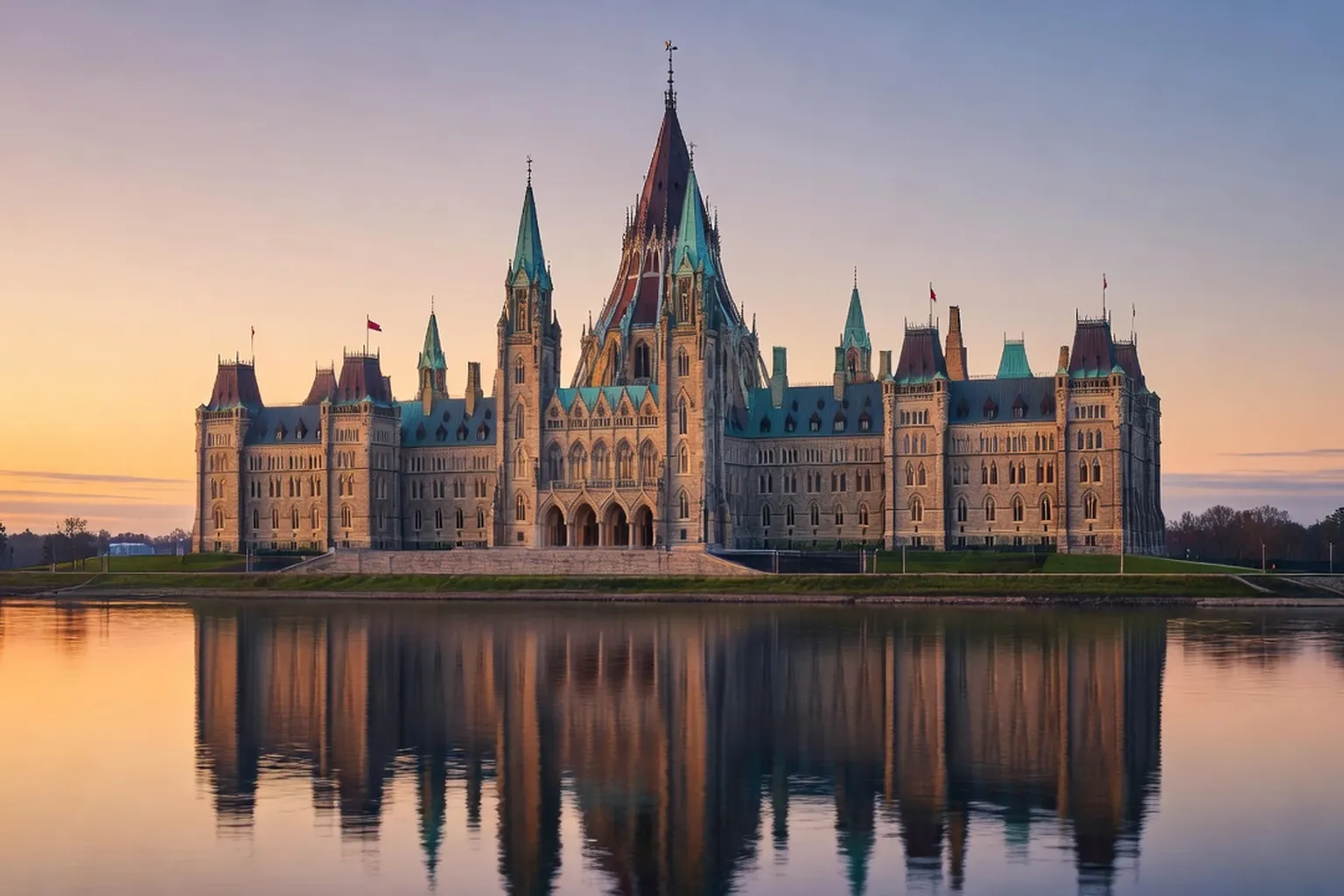
There is a particular hour, in Ottawa, when the copper roofs of Parliament Hill catch the slanting light off the river and turn the colour of a tarnished coin pulled from a pocket. It usually comes a little after seven in summer, a little after four in winter, and it tends to take visitors by surprise. They came expecting a polite capital — they get something older, slower, and stranger. Limestone walls. A canal that becomes a skating rink. A French city across a bridge. An Algonquin land underneath it all. The shortlist that follows is editorial, not exhaustive. It is the version we would give a friend who has three days and wants to walk a little slower than the average tourist.
The heritage triangle
If you only do one thing in Ottawa, walk the heritage triangle between Parliament Hill, the Rideau Canal locks and the Bytown Museum. The three sit within a five-minute walk of each other and they tell the story of why a city was placed here at all. Queen Victoria chose Ottawa in 1857 as a defensible inland capital, and the limestone hills along the river became the natural stage for the country’s institutions. The Centre Block of Parliament, with its central Peace Tower, has been closed for restoration since 2018, with construction on track for completion around 2031 and a public reopening expected in 2032, but the Hill itself remains open and the East and West blocks still operate. The grounds reward unhurried walkers: the Centennial Flame at the entrance, the statues along the lawns, the Library of Parliament’s polygonal silhouette behind the Centre Block, and the long view down to the river. Free guided tours run when the buildings are open; reservations open about a month in advance and they go quickly in July and August.
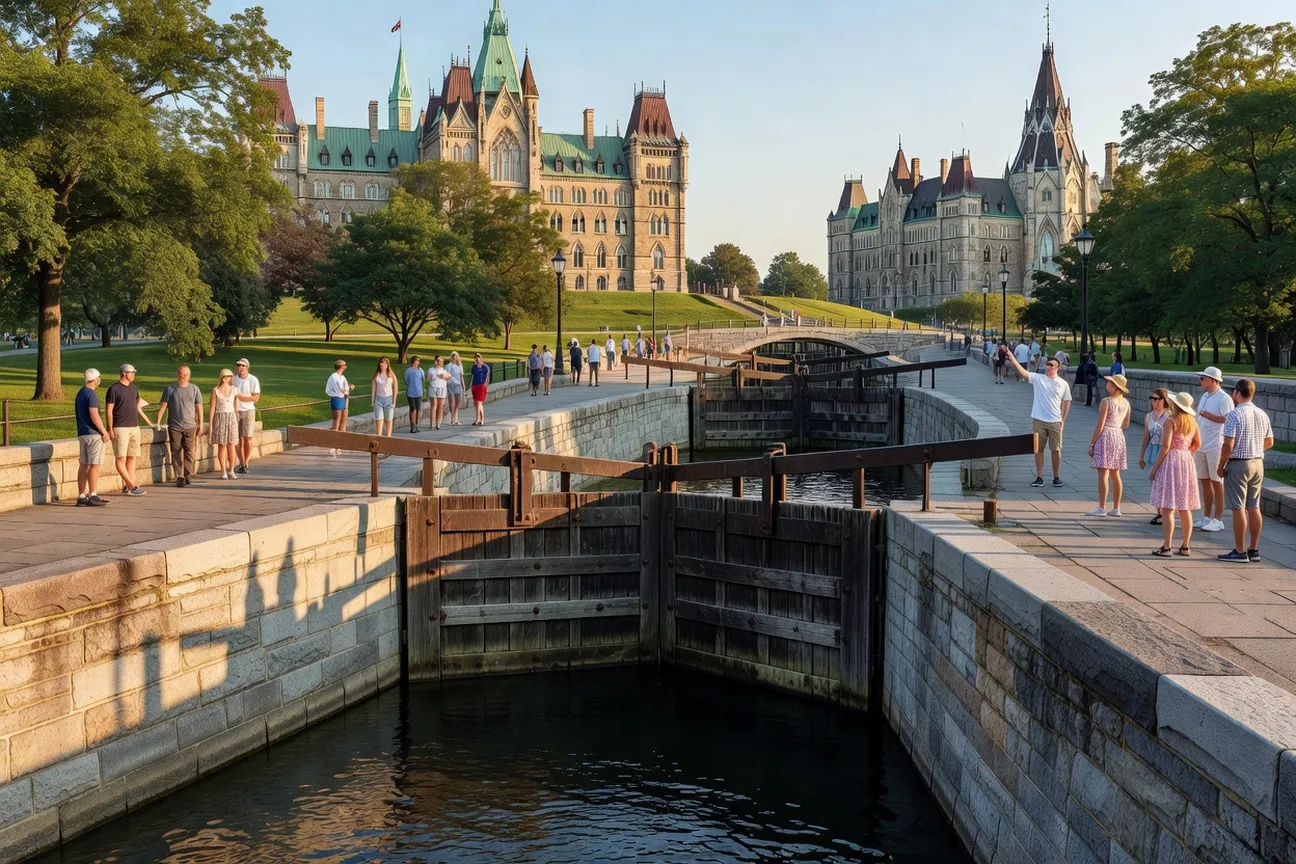
Down the slope, the eight locks of the Rideau Canal staircase carry water from the Ottawa River up into the canal’s first pool. The locks were dug by hand in the 1820s under Colonel John By, after whom the early settlement of Bytown was named, and they still operate every summer with their original wooden gates. Standing at the bottom of the staircase with the parliament copper above you and the locktender turning the iron crank by hand is one of the quiet pleasures of a visit. At the top of the locks, the small stone building that was once Colonel By’s commissariat now houses the Bytown Museum — a modest place but a useful one, with a clear chronology of the city’s first decades and a few good objects from the canal construction. Most visitors give it forty minutes. We would give it ninety.
The triangle is also the right place to start if you only have a single day in town, because everything else radiates from it. A clear field guide to the Hill’s institutions, including the territorial acknowledgement and the difference between the East and West Blocks, lives in our Parliament Hill field guide. The companion guide to the canal explains why UNESCO listed it in 2007 and how its character changes from spring to winter — see the Rideau Canal year-round field guide before you walk it.
| Stop | Time to allow | Best for |
|---|---|---|
| Parliament Hill grounds | 30-45 min (free) | The Centennial Flame, statues, the river view |
| Bytown Locks staircase | 20-30 min | Watching the locks operate by hand |
| Bytown Museum | 90 min | A clear chronology of the city’s first decades |
| East Block tour (summer only) | 45 min | The preserved Confederation-era offices |
| West Block / temporary Commons | 45 min | The glass-vaulted chamber |
Quick fact. The heritage triangle — Hill, locks, museum — sits inside a five-minute walking radius, which is why we recommend starting any Ottawa itinerary here regardless of season.
Canal & water
Ottawa is a water city. The Ottawa River runs east-west along its northern edge, separating Ontario from Quebec; the Rideau River runs south from the canal and tumbles over Rideau Falls into the Ottawa River near the Sussex Drive embassies; and the canal itself runs eight kilometres from the Bytown locks down to Dow’s Lake. To understand Ottawa as a city you really have to walk at least one stretch of the canal at a slow pace. Our preferred walk goes from the Bytown locks to the Pretoria Bridge — roughly forty minutes one way — and takes in the National Arts Centre, the original Confederation Building, and the long view back toward the parliamentary copper. In summer, do this around 7 p.m. when the rowing shells come out and the light goes long. In winter, lace on rented skates at the Patterson Creek hut and glide the same stretch in twenty minutes.
Boats matter here too. The Rideau River cruises that depart from the basin between the locks and the Château Laurier are the best way to see the parliamentary cliff from the water; the trip lasts about ninety minutes and is worth doing once. Beyond the canal, the Ottawa River is open for kayaking and paddleboarding from the small dock at the Lac Leamy beach on the Quebec side, and the rapids at Hog’s Back Falls, near Mooney’s Bay, are worth a five-minute look on a hot day for the way the water folds over the limestone shelves. For a quieter morning, walk the Voyageur Pathway along the Gatineau shoreline from the Museum of History to the Champlain Bridge — twenty minutes there, twenty back, and a complete change of pace from the downtown core.
The canal’s character flips between summer pleasure walk and winter skateway, but it is not the only year-round water in town. Read the seasonal field guide for a month-by-month account of when each body of water is at its best. Photographers chasing the light on these same stretches of water — the locks at dawn, the canal skateway at dusk, the river from the Quebec side — will want the best photography spots and scenic viewpoints across the city as a dedicated companion.
Markets & food
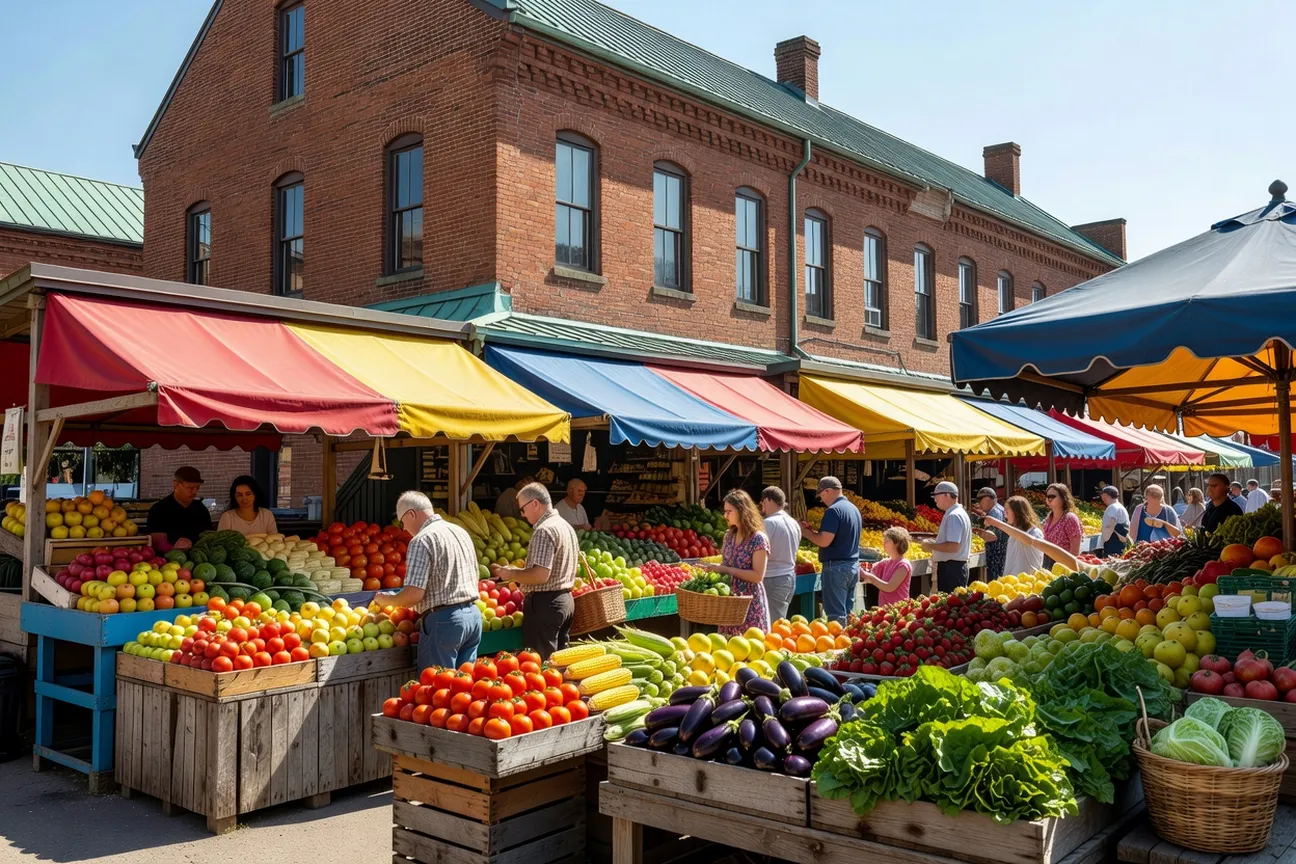
ByWard Market — Marché By to its French speakers — is the oldest continuously operating public market in Canada. The building at York and ByWard streets dates from 1926, but the market itself was platted in 1826 as the working heart of Bytown. Today it functions on three layers. The covered market is still the place to buy a maple sugar log or a paper bag of cheese curds from a regional dairy. The streets around it are a dense weave of restaurants, oyster bars and bakeries — Métropolitain for steak frites, Murray Street for charcuterie, ZenKitchen for vegetable-forward cooking, Beckta in the Grant House for a fine-dining anniversary. And in the small lanes off Clarence and Murray streets you will find the city’s most interesting independents: Mati Bar, La Bottega for Italian deli sandwiches at lunch, Play Food & Wine for tapas, the Métro Café for early morning espresso.
BeaverTails — flat-fried dough strips served with cinnamon sugar or chocolate-banana — were invented at the canal-side stand on George Street in 1978 and the original kiosk still draws a queue. We would not pretend it is a culinary highlight, but eating one on the canal in February is a small Canadian rite. For something more honest, find Saslove’s Meat Market for smoked deli; the Piggy Market for Ontario charcuterie; Mrs Tiggy-Winkle’s for the children. The market is also where most of the city’s craft cocktail bars cluster — Copper Spirits & Sights at the Andaz hotel, Union 613 for a Southern menu and bourbon, the General Bistro for a quieter glass.
For a deeper editorial guide to opening hours, vendors and the best evening to come — Thursday in summer, Sunday in winter — see ByWard Market after dark. And cross-reference with our cluster-3 partner voyage-canada.com on regional food for a francophone perspective on Ontario and Quebec cuisine.
Galleries & museums
Ottawa is, more than visitors expect, a museum city. The capital concentrates seven national institutions within a five-kilometre radius, and most of them belong on a shortlist. The National Gallery of Canada, with Maman the giant spider on its plaza, holds the country’s deepest collection of historical Canadian and Indigenous art; allow at least two hours and book your tickets online to skip the queue at the entrance. The Canadian Museum of History across the river in Gatineau is, in our view, the single best museum in the country: its Grand Hall of Northwest Coast totems, the First Peoples Hall, and the Canadian History Hall together give a sweeping introduction to who lives on this land and why. Allow three hours, four if you bring children.
The Canadian War Museum, at the foot of LeBreton Flats, has a brutalist concrete architecture that mirrors its difficult subject. It is not a comfortable visit but it is an essential one for anyone trying to understand modern Canada; the gallery on the World Wars and the LeBreton vehicle gallery in the basement reward an unhurried morning. The Canadian Museum of Nature, in a stone castle on McLeod Street, is a delight for families: the mammal hall, the dinosaur gallery, and the blue whale skeleton in the entrance atrium each draw their own enchantment. The Canada Science and Technology Museum to the south, the Canada Aviation and Space Museum to the east, and the Bank of Canada Museum downtown round out the national set — each of them small enough to do well in ninety minutes if you are tight on time.
Beyond the federal institutions, the Ottawa Art Gallery on Daly Avenue and the Diefenbunker Cold War Museum in nearby Carp are the two independents worth the diversion. We would skip the Royal Canadian Mint guided tour unless you are travelling with a child who has not yet seen what a billion-dollar gold bar looks like in person.
Outdoor escapes
The single greatest gift Ottawa gives its visitors is Gatineau Park. The park starts ten minutes from Parliament Hill across the river in Quebec, and it covers 361 square kilometres of mixed hardwood forest, lakes and granite outcrops. In spring, the trails are quiet and the trilliums bloom on the forest floor; in summer, Meech Lake and Lac Philippe fill up with swimmers and paddlers; in autumn, the Champlain Lookout becomes one of the iconic foliage spots in eastern Canada; and in winter, the cross-country ski network of more than two hundred kilometres operates as one of the best groomed Nordic systems in the country. Our editorial advice is to come twice — once in summer for the swimming, once in mid-October for the colour.
Inside Ottawa itself, the green corridors along the rivers and the canal give the city its character. The Sir John A. Macdonald Parkway runs along the Ottawa River from downtown to the Britannia Beach in the west, with a flat shared-use path that is excellent for a morning run or a slow Sunday cycle. The Rideau Canal eastern pathway, between the locks and Hog’s Back, is the corresponding southern route. On weekends in summer some of these parkways close to cars for the NCC Bikedays — a small but persistent local tradition that gives the city back to its cyclists for half a day. For something further afield, the Greenbelt’s Stony Swamp trails offer a quiet hour of pine forest five minutes from the airport, and the small wineries and apple orchards of the Ottawa Valley along the river toward Wakefield are a good Sunday excursion.
A complete editorial map of these escapes lives in our Gatineau Park year-round guide and a planning piece on regional day trips in Day trips from Ottawa. For green-travel-aware visitors, our French-language partner verygreentrip.com keeps a complementary inventory of low-impact regional escapes.
A short checklist for a half-day outdoor escape without a car:
- Cross the Alexandra Bridge on foot or bike (10 minutes from Parliament Hill)
- Pick up the Sir John A. Macdonald Parkway path westbound, or the Voyageur Pathway into Gatineau Park
- Bring water and a light layer — the riverside corridor is several degrees cooler than downtown
- Check the NCC Bikedays calendar if visiting on a summer weekend (some parkways close to cars)
- Allow 20 extra minutes to return before dusk, since street lighting thins out past the Britannia Beach stretch
Festivals & nightlife
Ottawa earns its rhythm from its festivals more than from its nightlife. The four anchors of the year are Winterlude in early February — ice sculptures along the canal and snow slides at Jacques-Cartier Park; the Canadian Tulip Festival in mid-May, a quiet but moving annual gift from the Netherlands that fills Commissioners Park with a million blooms; Canada Day on July 1st, a long, busy day on Parliament Hill with concerts, fireworks and the Snowbirds flypast; and the Ottawa Bluesfest in mid-July, ten days of large-scale concerts on the LeBreton Flats stage that anchor the city’s summer calendar. The smaller but excellent satellites — RBC Bluesfest, the Ottawa International Jazz Festival, Folk Festival, CityFolk, the Chamberfest in early August, the Bal Canada at Lac Leamy in September and the Canadian Film Festival in March — each draw their own circles.
After dark, the city is quieter than Montreal or Toronto, but it has its rooms. The Mercury Lounge in ByWard runs a serious cocktail and live music programme. House of Targ, in Old Ottawa South, marries arcade games with pierogis and live punk on weekends; it is a beloved local institution. Sala San Marco in Little Italy hosts swing nights for the city’s social dancers; the Rainbow Bistro on Murray runs a long-standing blues night. For a small museum-of-the-night experience, head to the Aberdeen Pavilion at Lansdowne Park during a Redblacks football game or a Senators hockey night at the Canadian Tire Centre, where the city’s sporting culture is more legible than its music scene. None of this competes with a Friday in Montréal, but it has the merit of being underbooked: you can usually walk into the venue you want on the night.
For a complete calendar with practical advice on Canada Day crowds, the Bluesfest beer-line strategy, and the Winterlude transit shutdowns, see our Festivals & events of Ottawa field guide. And to plan around them, the seasonal piece Best time to visit Ottawa lays out a twelve-month overview month by month. For a year-round Quebec angle, see our partner timetours-voyages.fr on cross-border travel planning.
Ottawa is a slow city by reputation and a layered city by reality. Walk it at the pace of the canal walkers and the old skaters, and it begins to give itself up.
The most useful posture, in the end, is to remember that you are walking on Algonquin Anishinaabe land — never ceded by treaty — and that the limestone walls of Parliament and the canal beneath them are an overlay of nineteenth-century engineering on a much older waterway. The official territorial acknowledgement that the Government of Canada now opens its proceedings with is not a piece of bureaucratic politeness; it is a small recognition that the city sits in someone else’s house, and that the host has been patient. With that perspective, the shortlist above stops being a checklist of monuments and becomes a way of meeting the place.
Frequently asked
Walk the heritage triangle on foot: Parliament Hill, the Rideau Canal locks, and the Bytown Museum. The three sit within a five-minute walk of each other and tell the story of why the city is here at all.
Three full days lets you do the heritage triangle, one museum, ByWard Market, and a half-day across the river in Gatineau Park. Add a fourth day if you want a day trip to Wakefield, Montebello or Calabogie.
The downtown core, ByWard Market, Parliament Hill and the Rideau Canal locks are all within a 20-minute radius on foot. For Gatineau Park or Westboro you will want OC Transpo, a rental car, or a taxi.
Yes. The Canadian Museum of History, the Gatineau Park trails and the Mackenzie King Estate are all on the Quebec side of the river. Ottawa makes more sense once you have stood on the opposite shore and looked back at it.
Start at Parliament Hill at 9 a.m., walk down the locks to the canal, cross the Alexandra Bridge to the Museum of History for one hour, come back for lunch in ByWard, and finish with a sunset stroll along the canal between the Château Laurier and the National Arts Centre.
Late September for autumn light and quiet streets, mid-May for the Tulip Festival, or late January for Winterlude on the canal skateway. Summer is the busiest. Read the seasonal field guide for a month-by-month breakdown.