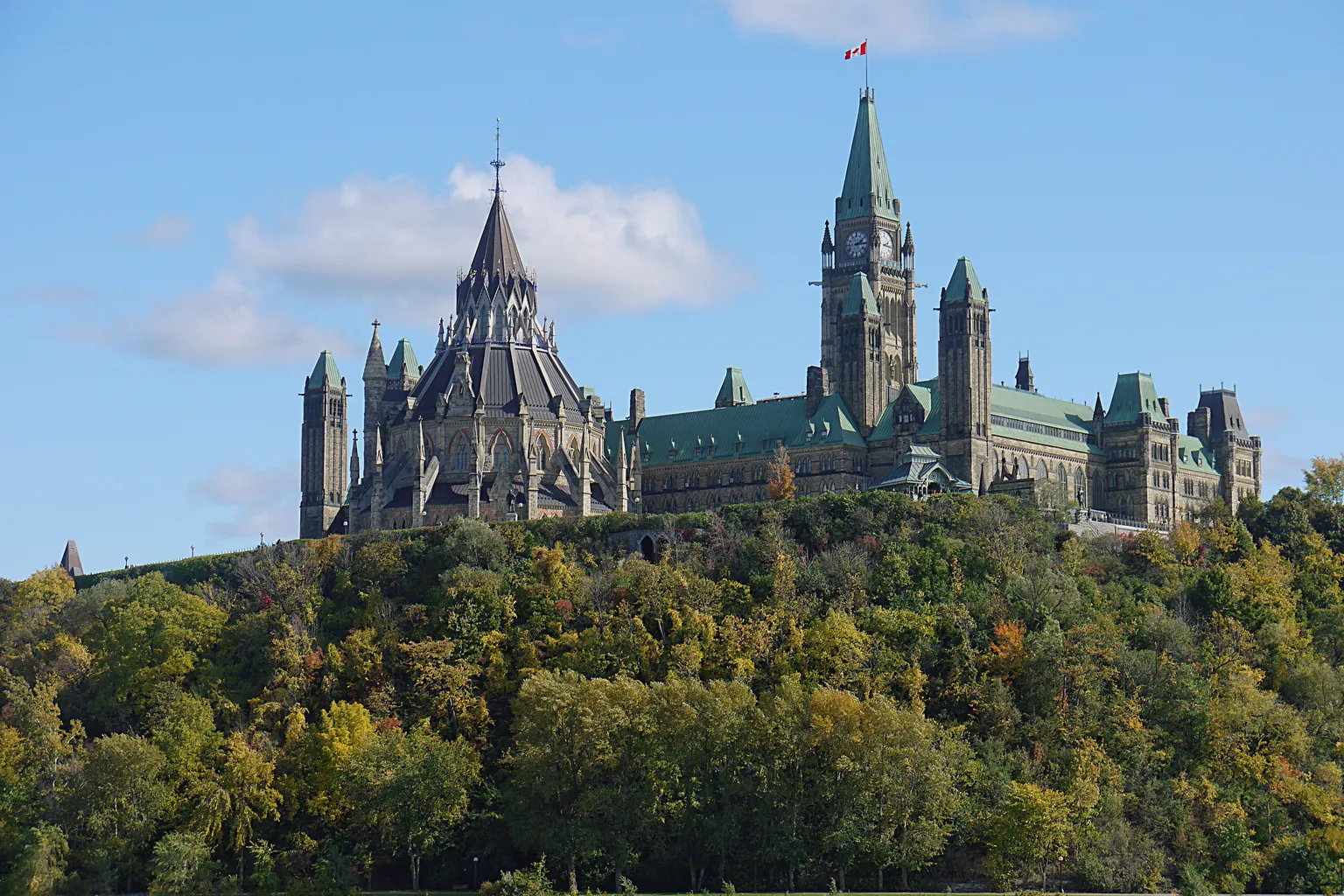
Parliament Hill is the seat of Canada’s federal government and the symbolic heart of the national capital: a limestone terrace above the Ottawa River in downtown Ottawa, ringed by the Gothic Revival blocks of the parliamentary precinct. The limestone hill on which it sits was not, originally, a political site. It was a logging point on a turn of the Ottawa River, a place where Algonquin Anishinaabe families had fished and traded for at least four thousand years, and a place where Colonel John By’s surveyors found a flat upper terrace useful for storehouses during the 1820s canal construction. The choice of this terrace as the seat of a national legislature came in 1857, when Queen Victoria — asked by the Province of Canada to settle a quarrel between Montreal, Toronto, Quebec and Kingston about where to put a capital — chose the inland lumber town of Ottawa for its defensive distance from the American border. Construction of the original Centre Block began in 1859. The buildings have burned once, been rebuilt, partially closed and slowly restored. They remain, despite the wood smoke of a wartime past and the wood scaffolding of a present rehabilitation, one of the most quietly moving public sites in Canada.
Architecture & restoration
The Parliamentary precinct is composed, in formal terms, of three buildings: the Centre Block, the East Block and the West Block. All three were designed in the Gothic Revival idiom favoured in the 1860s for monumental public architecture; their copper roofs, ornate dormers, lancet windows and slender towers were chosen to project an image of a young dominion that wished to be read as both modern and ancient. The buildings were largely complete by 1876. The original Centre Block burned in February 1916 — only the Library of Parliament at the rear survived because of its iron firedoors, which a quick-thinking librarian named Connolly MacCormac slammed shut as the flames approached. The Centre Block was rebuilt between 1916 and 1927 in a more austere Gothic style by the architects John Pearson and Jean-Omer Marchand. The Peace Tower, which rises 92 metres above the central pediment, was added during the rebuilding as a memorial to the Canadian dead of the First World War. Its carillon of 53 bells still plays a daily noon concert that drifts down the slope to the canal.
Readers who want to see this Gothic Revival vocabulary in context, and trace how it echoes through the streets beyond the Hill, can follow a self-guided architecture walking tour from Parliament Hill to ByWard Market, which maps the copper roofs and lancet windows against the later stone and brick of Lower Town.
The current restoration of the Centre Block, which began in 2018 and is on track for construction completion around 2031 (with the public reopening following in 2032, after a period of testing), is the largest heritage construction project in Canadian history. The whole interior is being stripped, seismically reinforced, restored stone by stone and modernised — for accessibility, for fire safety, for the digital broadcasting of debates, for the inclusion of the Indigenous and gender symbols that the original 1920s vocabulary excluded. Visitors are not currently allowed inside, but a viewing platform at the corner of Wellington and Metcalfe lets the curious see the scaffold and the dismantled stonework. The West Block, restored between 2011 and 2018, is now the temporary home of the House of Commons; its inner courtyard was rebuilt as a glass-roofed chamber and is, in the view of many Ottawans, the single most beautiful new public room in the country.
Tours & visits
Free guided tours operate year round and are the only way to see most of the interiors of the parliamentary buildings. They are run by the Library of Parliament’s visitor services team and they start from the Visitor Welcome Centre at 110 Wellington Street, just east of the West Block. Visitors working out how to get here should note that the Confederation Line and several bus routes stop within a short walk of the Hill; our getting around Ottawa guide covers the practicalities. Tours fill quickly in July and August; book online about a month in advance, or arrive in person at 8.30 a.m. for the day’s released tickets. There are three tour streams: the temporary House of Commons inside the West Block (offered when the Commons is not sitting); the East Block, which preserves the offices used by the Fathers of Confederation and is open only in summer; and the Senate of Canada Building on Rideau Street, the temporary home of the Senate, which is open year round and is, surprisingly, the most architecturally striking of the three. We would prioritise the Senate tour and the East Block tour over the West Block in a tight schedule.
| Building | Access during restoration | Tour season |
|---|---|---|
| Centre Block | Closed since 2018, reopening progressively from 2031 | Not open |
| West Block (temporary Commons) | Open on non-sitting days | Year round |
| East Block | Fathers of Confederation offices preserved | Summer only (late June-Labour Day) |
| Senate of Canada Building (Rideau St) | Temporary Senate home | Year round |
Tip. With a tight schedule, prioritise the Senate of Canada Building and the East Block over the West Block — both are less crowded and, in our view, more architecturally rewarding.
Beyond the buildings, the grounds reward a slow ninety minutes of walking on their own. Start at the Centennial Flame at the entrance gates, walk clockwise past the statues of the Fathers of Confederation, the monument to the Famine Migration on the western lawn, and the equestrian statue of Queen Elizabeth II near the back of the Hill; finish at the long platform that looks down to the river and across to the Canadian Museum of History in Gatineau. The platform is one of the great urban views in Canada. For a careful field guide to the canal beneath the Hill, see our Rideau Canal field guide, and for nearby day excursions our Day trips from Ottawa piece.
The Centennial Flame
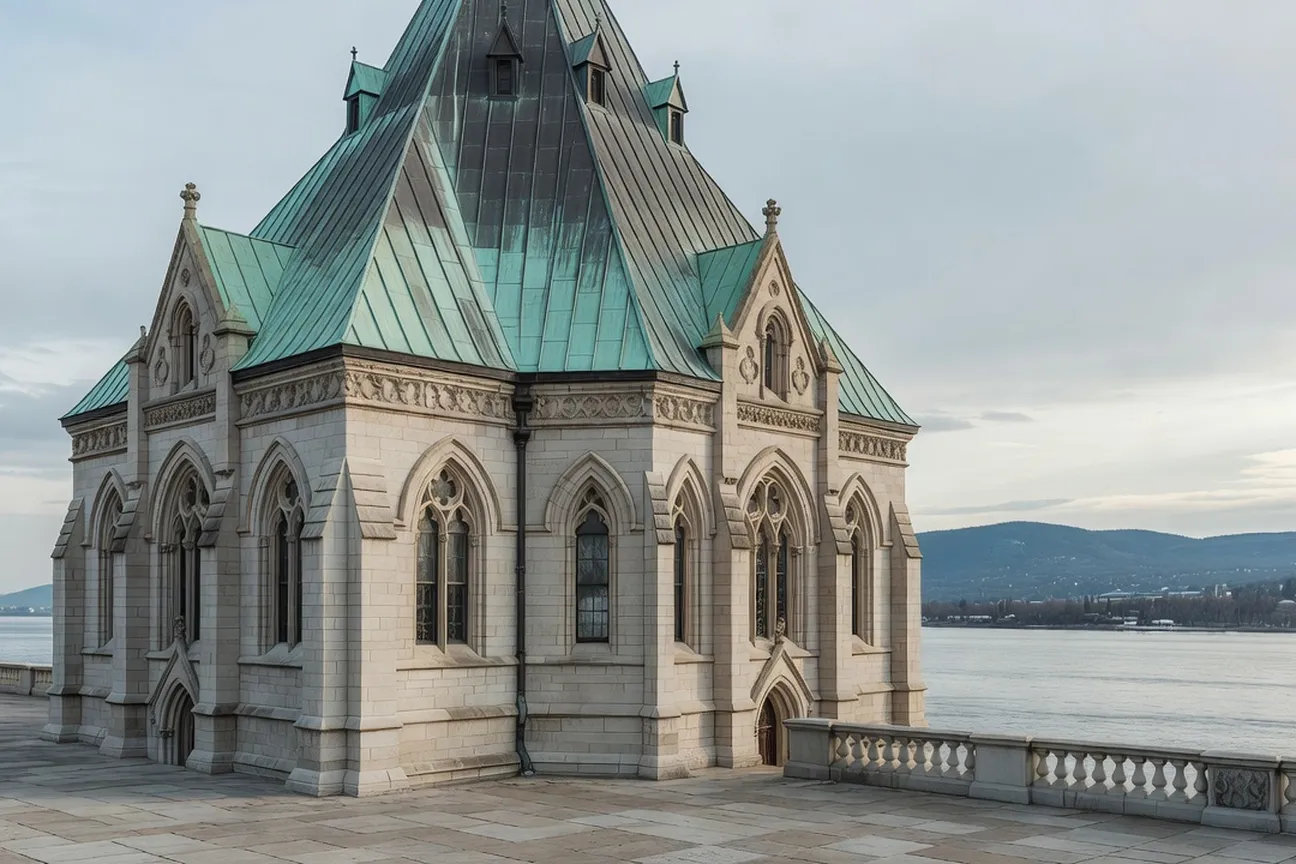
The bronze fountain at the foot of the Hill was lit on the night of December 31, 1966, to mark the centennial of Confederation in 1967. It has burned continuously ever since. The flame rises from the centre of a low limestone basin around which are arrayed the coats of arms of all ten provinces and the three territories — Nunavut, added in 1999, has its own quieter inscription. The water of the basin is heated by the natural gas flame so that the fountain runs clear even in February; passers-by sometimes drop a coin into the basin in a small private ritual, and the coins are collected once a year and donated to programmes for Canadians with disabilities.
We would not visit Parliament Hill without taking five quiet minutes at the flame. It is a small, deliberate piece of civic memory — the gentlest possible introduction to the federal architecture above. If you arrive at dusk in February, the steam rising from the heated water against the cold air, the flame against the limestone, and the lit copper of the Peace Tower above make one of the most photographed scenes in the city.
The Library of Parliament
Behind the Centre Block, at the very back of the Hill where the limestone falls to the river, stands the polygonal silhouette of the Library of Parliament. Designed by the architects Thomas Stent and Augustus Laver and completed in 1876, the Library is a sixteen-sided wooden-and-stone rotunda inspired by the chapter houses of medieval English cathedrals. Inside, three tiers of white pine bookshelves rise to a domed ceiling carved with a thousand small ornaments — Indigenous masks, Canadian flora, the royal coat of arms, the personal devices of the architects’ apprentices. It is, by common consent, the most beautiful interior in the country.
The Library survived the 1916 fire because of Connolly MacCormac’s iron doors. It survived the 1952 dome fire because of a quick reinstatement of those same doors by a different librarian. And it survived the long structural fatigue of its iron frame because of an extensive restoration between 2002 and 2006, in which the entire dome was lifted, the interior strengthened against earthquake, and the wooden bookcases re-conserved by a team of dozens of joiners working in a temporary workshop on Sparks Street. It is currently closed to the public as part of the Centre Block restoration. We expect tours to resume after the Centre Block reopens around 2031.
The Library still operates as a working research library for parliamentarians and their staff. Its head librarian is appointed by Order in Council and reports jointly to the Speakers of the Senate and the House of Commons. It is the oldest continuously operating institution of the Canadian federal state, founded by an Act of the Province of Canada in 1841.
East & West blocks
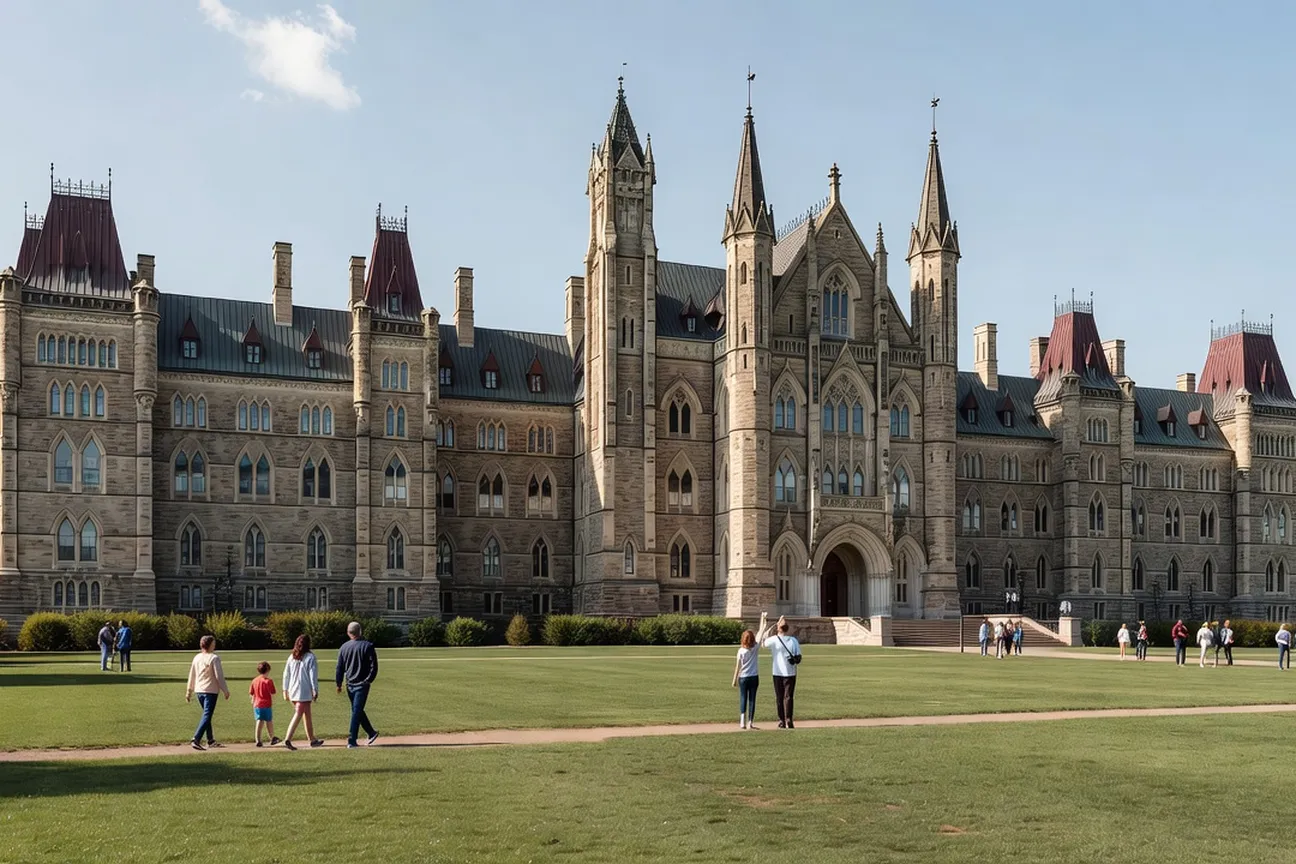
The East Block, which closes the parliamentary square on the eastern side, is the most quietly important building on the Hill for anyone interested in the history of Canadian federalism. It was completed in 1865 — two years before Confederation — and its second-floor offices were the original workspace of the Fathers of Confederation. The room used by Sir John A. Macdonald as office and cabinet room has been preserved, with the original furniture, papers and even the wallpaper restored from photographic evidence. The room used by Sir George-Étienne Cartier, his French Canadian co-architect of Confederation, has been similarly preserved next door. The two rooms together are, in the view of historians, the most authentic surviving political interior of nineteenth-century Canada. The East Block is open for guided tours only in summer, between late June and Labour Day in early September; advance booking is recommended.
The West Block, which closes the precinct on the western side, was completed in 1866 and used for a century and a half as the working offices of cabinet ministers and committees. Between 2011 and 2018, in preparation for the Centre Block restoration, its entire interior was emptied and the formerly open inner courtyard was reroofed as a glass-vaulted chamber to serve as the temporary House of Commons. The new chamber is one of the country’s great new public rooms: the green leather benches of the Commons, the historic Speaker’s chair brought across from the Centre Block, the limestone walls of the original outer building, and a glass-and-steel ceiling that lets natural light into the proceedings. Visitors can see the chamber during the West Block tour. When the Commons returns to the Centre Block around 2031, this West Block chamber will become a multipurpose committee and ceremonial space; it is too beautiful, and too useful, to be allowed to go quiet.
Algonquin territory
The limestone bluff on which Parliament Hill sits — known in Algonquin Anishinaabemowin as Aksinawisipi, the place where the Rideau River falls into the Ottawa — has been part of the Algonquin Anishinaabe nation’s homeland for at least four thousand years. The land was never surrendered by treaty. The 1763 Royal Proclamation of King George III recognised an unceded indigenous title across all of British North America that had not been formally bought from its first nations, and Ottawa sits in the heart of one of the largest of those unceded territories — roughly the entire Ottawa River watershed, from the headwaters in northern Quebec down to Montreal.
Since 1991, the Government of Canada has been negotiating a modern treaty with the Algonquins of Ontario and, separately, with the Algonquins of Pikwakanagan First Nation. Both negotiations remain incomplete. The federal government opens its proceedings with a territorial acknowledgement of the unceded Algonquin Anishinaabe nation as host, and individual federal departments, the Senate and the Commons all include the acknowledgement in their public business. It is not a piece of bureaucratic decoration: it is a small, public, careful recognition that the parliamentary buildings sit on someone else’s land and that the host nation is owed the courtesy of being named.
Before visiting, a few points to keep in mind:
- The Hill sits on unceded Algonquin Anishinaabe territory, never surrendered by treaty
- Treaty negotiations between Canada and the Algonquins of Ontario / Pikwakanagan First Nation have been ongoing since 1991
- The federal government opens official proceedings with a territorial acknowledgement
- The First Peoples Hall at the Canadian Museum of History gives a fuller account of Algonquin and other Indigenous histories
- Mādahòkì Farm, on the city’s western edge, offers Indigenous-led cultural tours and seasonal events
Visitors who would like to learn more before walking the Hill have two practical options. The First Peoples Hall at the Canadian Museum of History across the river, fully renewed in 2017, gives a careful account of the Indigenous peoples of Canada including the Algonquins. And the Mādahòkì Farm on the western edge of the city, run by Indigenous Experiences Ottawa, offers cultural tours and seasonal events that introduce visitors to Algonquin storytelling, food and music. Both add depth to the walk on the Hill; both are worth a separate visit.
Parliament Hill is a beautiful place, but it is not, in the end, the most important place in this story. The most important place is the river below it, and the long Algonquin presence that the river represents.
For practical planning around the heritage triangle, see our Things to do in Ottawa shortlist, and for a French-language angle on the same heritage from a Quebec perspective our cluster partner voyage-canada.com. Detailed accessibility, opening hours and tour-booking instructions are kept up to date on the official Parliament of Canada visitor pages at parl.gc.ca, and on the National Capital Commission site ncc-ccn.gc.ca for the surrounding grounds and parks.
Frequently asked
The grounds remain open year round and are free to visit. The Centre Block has been closed for a major restoration since 2018 and is on track for construction completion around 2031, with a public reopening expected in 2032 after post-construction testing. The East Block opens for guided tours in summer, and the temporary House of Commons in the West Block is open during sittings.
The House of Commons currently sits in the rebuilt courtyard of the West Block, and the Senate has moved temporarily to the former Government Conference Centre on Rideau Street, near the Château Laurier.
The Library is part of the Centre Block restoration site and is not currently open. It was restored in 2002–2006 and is one of the few interiors to survive the 1916 fire intact. We expect tours to resume once the Centre Block reopens to the public, expected in 2032.
Yes. The Ceremonial Guard performs the daily changing of the guard on the front lawn of Parliament Hill between late June and late August, weather permitting. The ceremony begins at 10 a.m. and lasts about thirty minutes.
Ottawa sits on unceded Algonquin Anishinaabe territory. The land was never surrendered by treaty. The federal government and the Algonquins of Pikwakanagan First Nation have been negotiating a modern treaty since 1991. Acknowledging the territory is a small, public way of recognising that the city is a guest on land that has its own host nation.