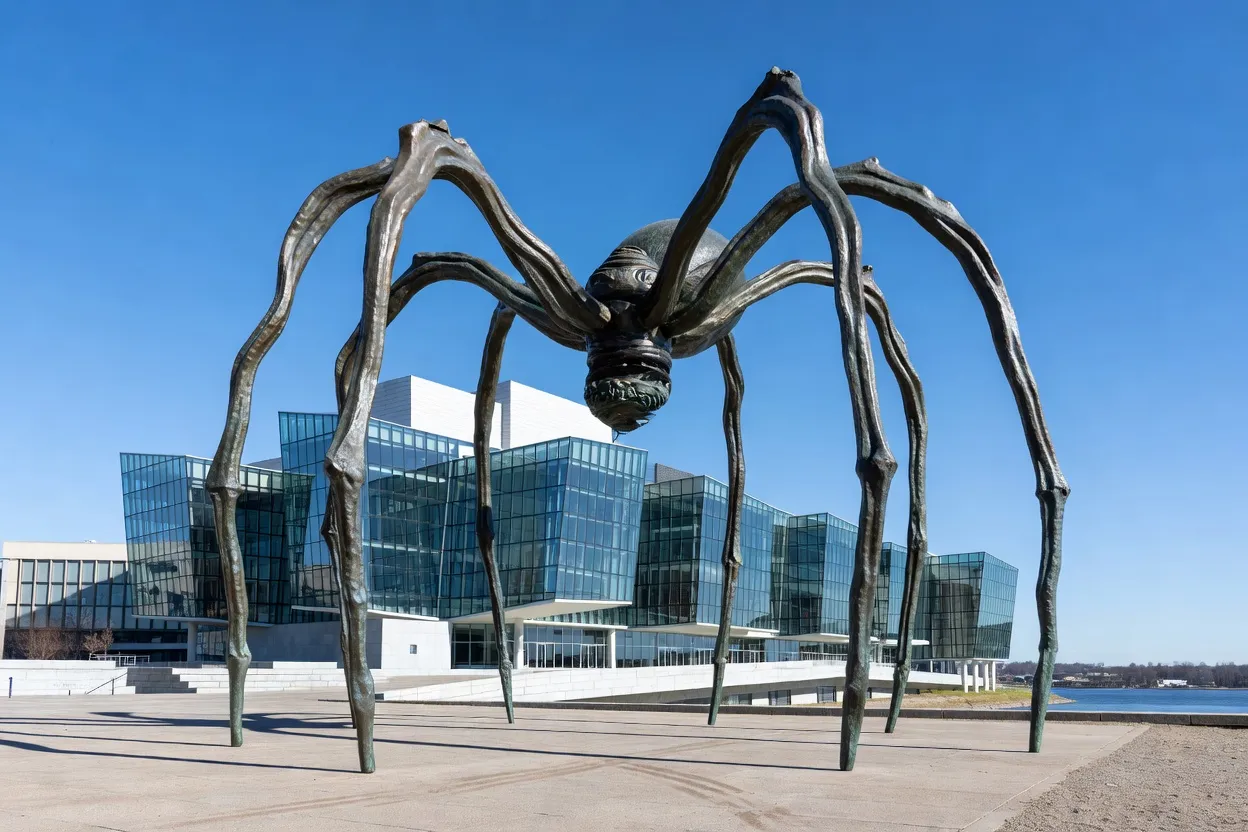
A practical self-guided route starts at the National Gallery of Canada on Sussex Drive, passes the large spider sculpture by Louise Bourgeois known as Maman, follows Confederation Boulevard past key landmarks, enters the ByWard Market neighbourhood for murals along several blocks, detours briefly to Ottawa City Hall, and returns through Confederation Park, covering roughly four kilometres over two to three hours at a steady pace.
The route pairs naturally with the site’s Parliament Hill heritage guide and the Rideau Canal field guide for visitors extending the walk beyond the central art circuit.
Beginning at the National Gallery of Canada
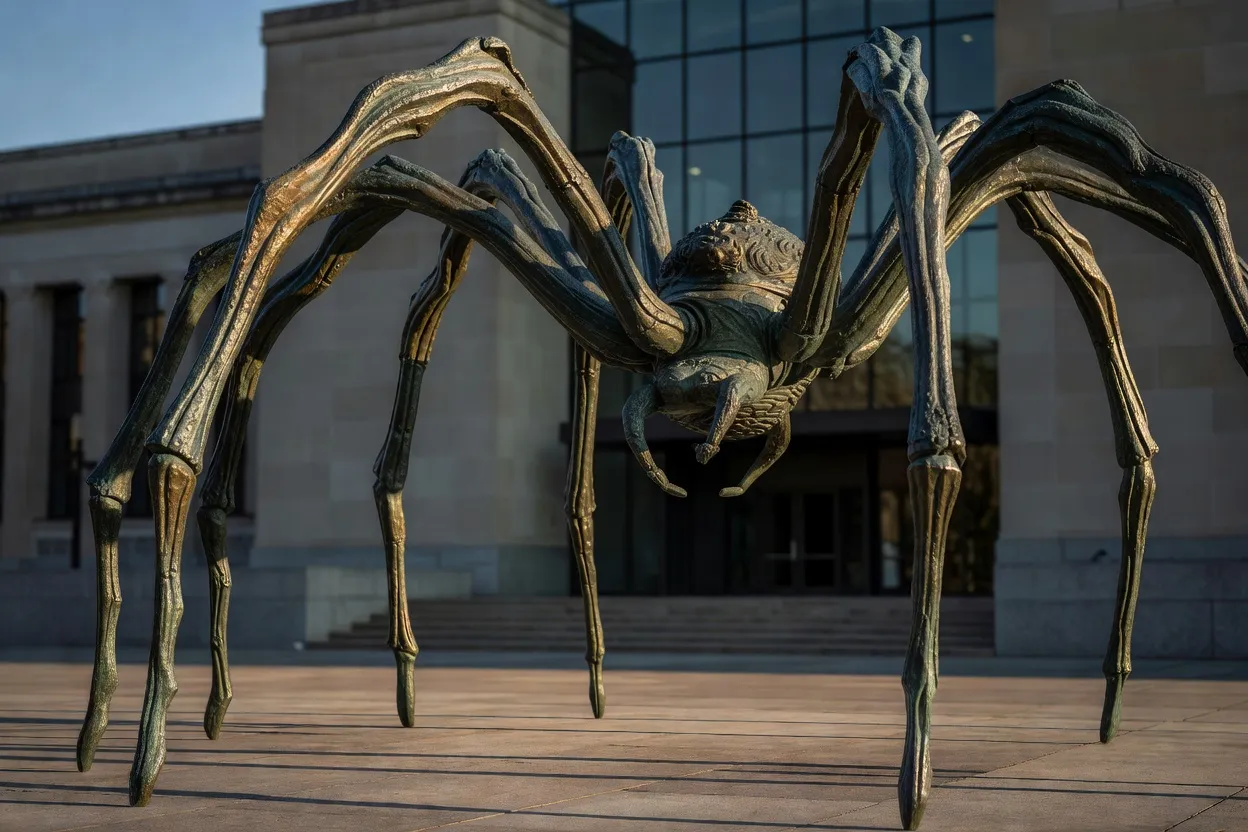
The National Gallery provides an immediate focal point for any downtown art walk because its forecourt holds one of the cast versions of Maman, the oversized bronze spider created by Louise Bourgeois. The sculpture sits directly outside the building entrance, allowing visitors to examine its scale and texture before entering the gallery or continuing onward. From this location the route heads south along Sussex Drive toward the ceremonial axis of Confederation Boulevard. The boulevard itself forms part of the National Capital Commission pathway system, where additional sculptures appear at regular intervals among the trees and open plazas. These pieces range from abstract metal forms to figurative works commemorating historical events, all maintained under the same NCC program that links Parliament Hill with the National War Memorial and other central sites. A short pause at each installation reveals how the commission positions art to frame views of the surrounding federal buildings rather than compete with them.
Following Confederation Boulevard
Confederation Boulevard functions as the spine of the walk because it connects multiple national institutions in a single continuous line. After leaving the gallery grounds, the path crosses the Rideau Canal and continues past open lawns where low-profile sculptures sit close to the pavement. These works encourage pedestrians to slow down and notice changes in material and shadow throughout the day. The boulevard’s design integrates lighting and seating so that larger groups can gather without blocking foot traffic. For readers planning a longer day, the same route appears in greater architectural detail in the Ottawa architecture walking tour from Parliament to ByWard, which overlaps here for several blocks. The National Capital Commission updates its public-art inventory periodically, so newer pieces occasionally replace older ones along the same stretch.
Murals and Street Art in the ByWard Market Area
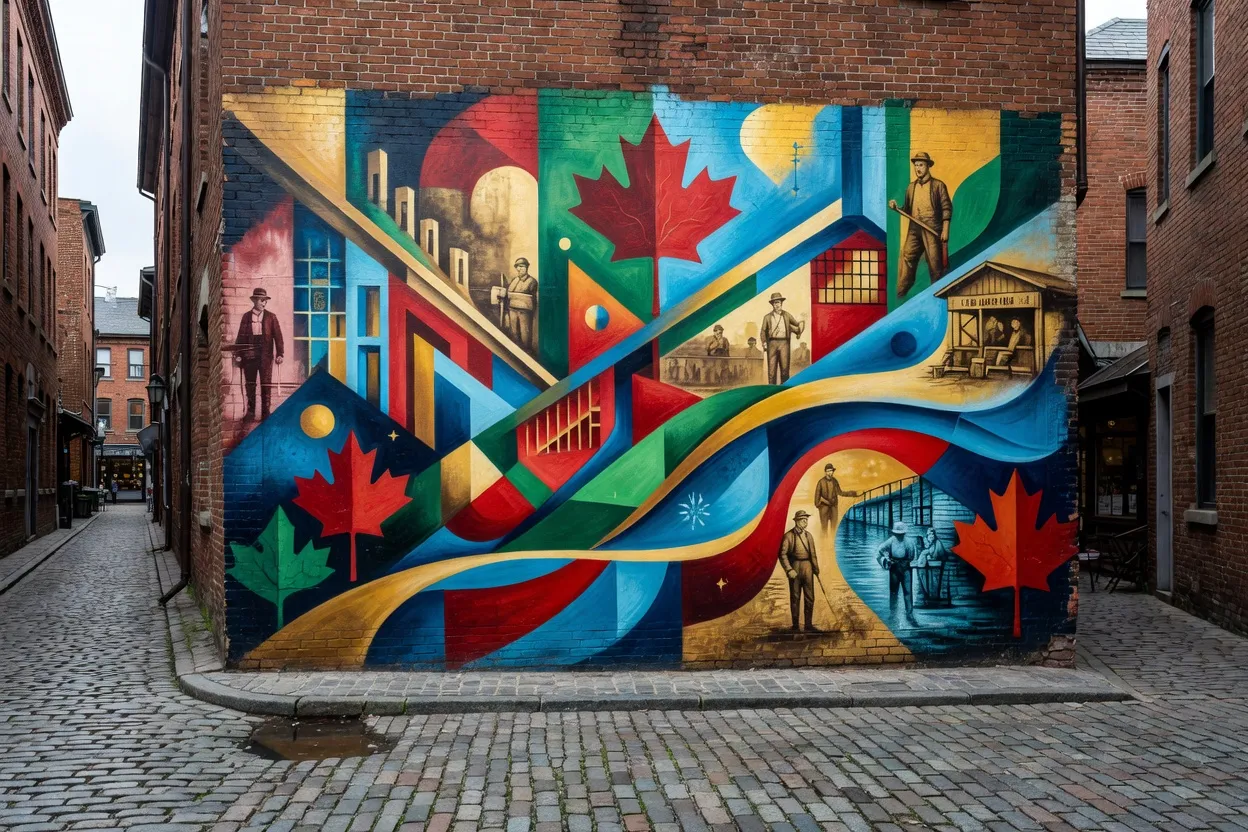
Once the boulevard reaches the edge of the ByWard Market neighbourhood, the character of the artwork shifts from commissioned sculpture to wall-based murals. City and community mural programs have supported paintings on brick and concrete surfaces along George Street, York Street, and adjacent side lanes over successive years. Many of these works depict local history or abstract patterns without named individual credits on the street itself. The murals occupy secondary walls rather than primary storefronts, which keeps them visible yet integrated with everyday commercial activity. Walking east to west through the market grid takes roughly twenty minutes and reveals a rotating handful of large-scale pieces, with the exact count and locations shifting as murals are refreshed or replaced through ongoing maintenance schedules. The neighbourhood layout allows easy detours into quieter lanes where smaller interventions appear on utility boxes and temporary hoardings.
A Suggested Short Walking Loop
One efficient loop begins at the National Gallery, proceeds south on Sussex Drive to the War Memorial, turns east into the ByWard Market for two blocks of murals, then returns west along Rideau Street to Confederation Park before circling back to the gallery in approximately ninety minutes. This circuit avoids steep grades and keeps most segments on wide sidewalks with frequent benches. A second practical scenario suits visitors who prefer a half-day outing: start at Ottawa City Hall in the late morning, examine the sculptures in its plaza, cross into Confederation Park for additional works, continue north to the market murals, and finish at the gallery in time for an afternoon visit. Both loops connect directly to the broader list of things to do in Ottawa when more time remains.
Detour to Ottawa City Hall and Confederation Park
A brief side trip from Confederation Boulevard leads to Ottawa City Hall on Laurier Avenue, where several abstract sculptures occupy the surrounding plaza. The works vary in height and material, offering different sightlines from the adjacent streets. Confederation Park lies immediately south of the city hall complex and contains its own cluster of commemorative pieces set among formal gardens and pathways. The park functions as a natural rest point because it provides shade and open space between denser downtown blocks. From here the route can rejoin the main boulevard or continue toward additional NCC-managed segments along the canal.
Practical Considerations for the Walk
Preparation keeps the route comfortable across changing weather and daylight conditions. A compact list of items includes comfortable walking shoes with good grip, a reusable water bottle, a small notebook for recording observations, and a charged phone with an offline map downloaded in advance. Another useful list covers timing choices: early morning offers fewer crowds near the gallery, midday provides the strongest light on murals in the market, and late afternoon suits photography along the boulevard when shadows lengthen across the sculptures. Approximate distances between major stops appear in the table below for planning purposes.
| Segment | Approximate Distance | Estimated Time |
|---|---|---|
| National Gallery to War Memorial | Short walk | ~10 min |
| War Memorial to ByWard Market murals | Short walk | ~10 min |
| Market murals loop | About 1 km | 15-20 min |
| Return via Confederation Park | About 1-1.5 km | 15-20 min |
These are approximate walking segments for planning purposes – actual distance varies with the exact route chosen through the market’s grid of streets. Seasonal adjustments matter as well. Summer heat encourages starting earlier, while winter requires extra layers and awareness of icy patches on the NCC pathways.
Photographing Public Art Without Disrupting the Space
Public sculptures and murals along this route sit in active civic spaces, which shapes how visitors should approach photography. Maman’s scale rewards photographs taken from several angles and distances rather than a single close frontal shot, since the sculpture’s legs and body read differently depending on the light and the surrounding crowd density; early morning generally offers the clearest sightlines before tour groups arrive. Along Confederation Boulevard, sculptures are frequently positioned to frame a specific view of a federal building behind them, so photographers who move a few steps to either side often find a more deliberate composition than the one immediately visible from the main path. In the ByWard Market, mural photography works best with a wide angle given the narrow lanes, and visitors should be mindful that many murals sit above active loading zones or building entrances still in daily commercial use, so lingering directly in doorways to get a shot can inconvenience business operations during working hours.
Extending the Route Toward the Canal and Beyond
Visitors with additional time can extend the loop south along the Rideau Canal pathway, where the National Capital Commission periodically rotates temporary installations and seasonal displays alongside its permanent sculpture collection. This extension adds roughly forty-five minutes to an hour depending on pace and adds canal-side benches as natural rest points between viewing stops. The extended route also offers a useful alternative starting point for visitors already covering the Rideau Canal UNESCO heritage sites, since several sculpture placements sit close enough to canal lock stations to combine both themes without significant backtracking. Visitors interested in architecture as much as sculpture may find this extension particularly rewarding, since the canal corridor exposes a wider range of building styles from different eras than the more uniformly ceremonial Confederation Boulevard segment.
Tip: Photograph Maman from several angles and distances rather than one frontal shot – the sculpture’s scale reads differently depending on the light and crowd density.
What to Bring and When to Go
Comfortable footwear matters more on this route than on many downtown itineraries because the walk mixes paved boulevard, uneven older sidewalks near the market, and occasional grass detours through Confederation Park. A phone with an offline map is useful since some of the smaller mural-lined lanes are not clearly signed and can be easy to miss on a first pass. Visitors who want to read more about individual artworks before setting out will find that on-site plaques vary in detail: major sculptures along Confederation Boulevard typically carry a small identification plate, while community murals in the market area more often rely on local knowledge or community association materials rather than posted signage. Weekday mornings tend to offer the calmest experience at the National Gallery forecourt, while weekend afternoons bring larger crowds throughout the market section, which can add atmosphere but also make careful photography more difficult.
Frequently asked
Most visitors complete the roughly four-kilometre circuit in two to three hours, including time to pause at each artwork.
The route uses mostly level sidewalks and paved pathways, though some curb cuts vary in quality near the market lanes.
Yes, the boulevard segment links directly to Parliament Hill, allowing an extension described in the Parliament Hill Canadian heritage guide.
Murals along market streets receive periodic upkeep through city and community programs, so individual pieces may be refreshed or replaced over time.
The National Gallery curator interview on this site provides additional context on the collection and outdoor installations like Maman.