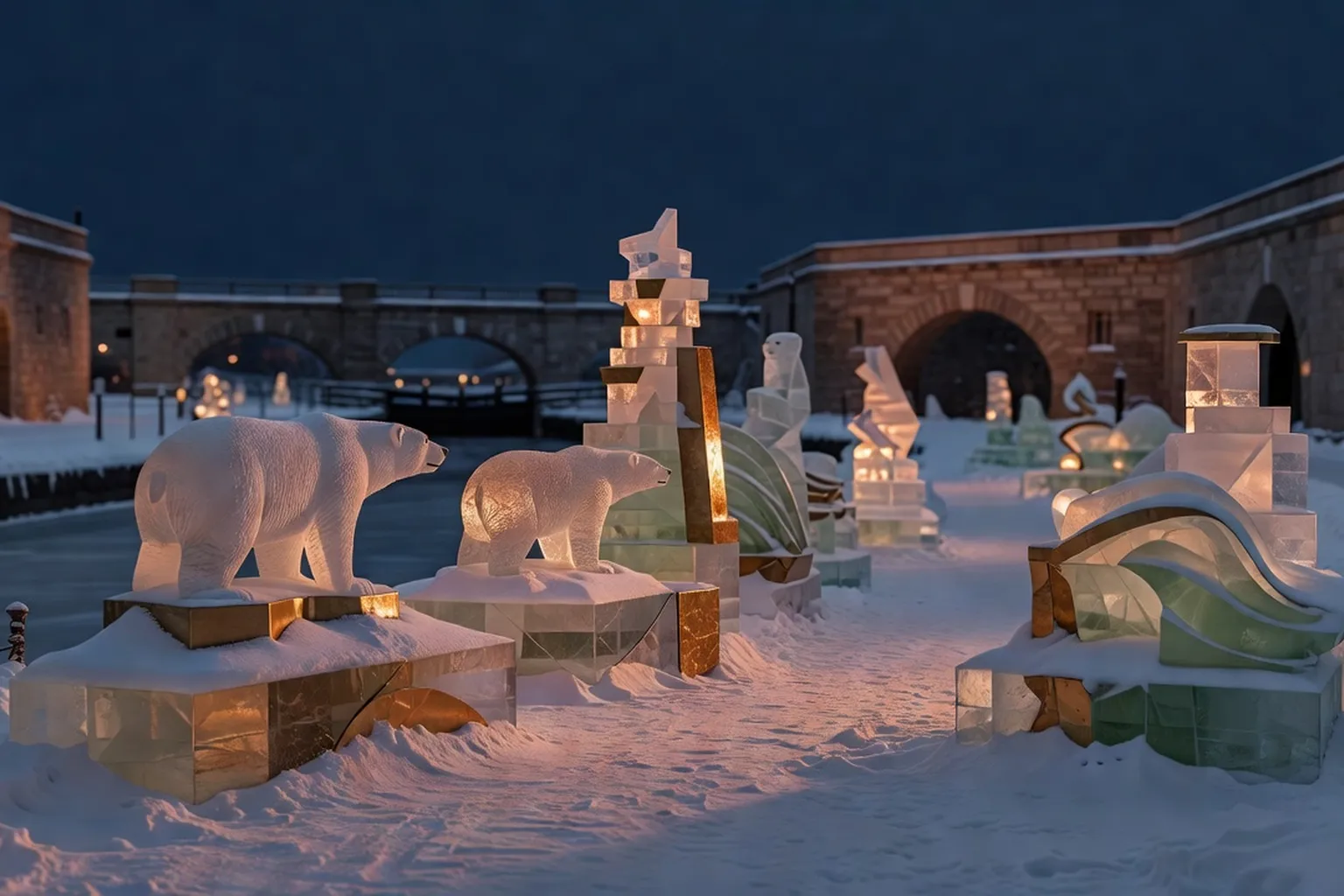
The air along the Ottawa River holds a persistent dryness in February, when winds from the west carry fine snow across the Alexandra Bridge and the temperature settles near minus twelve degrees Celsius for days at a stretch. Street-level snowbanks reach the height of a car door, their surfaces hardened by repeated ploughing, while the low sun produces long blue shadows that shift only a few degrees across the course of an afternoon. Pedestrians move between these banks in heavy layers, their breath visible for several paces before it disperses.
Winterlude occupies a fixed place within this seasonal pattern. The festival began in 1979 as a municipal response to the long period of cold that follows the holiday season. It occupies roughly two weeks, usually opening on the first Friday in February and closing on the third Sunday. Organisers schedule the dates to coincide with the period when average daily temperatures remain below minus ten degrees Celsius, ensuring that both ice and snow retain structural integrity. Programming centres on three primary sites: the Rideau Canal, Confederation Park, and Jacques-Cartier Park. Attendance figures vary from year to year depending on weather and the calendar, but the festival draws large crowds across its three weekends, with visitors travelling from across the region and beyond. Check the official Winterlude site for the most recent attendance reporting.
What Winterlude actually is
Ottawa’s holiday season kicks off well before Winterlude, with Christmas markets and holiday light displays in late November opening the winter calendar and setting the mood for the ice-carving weeks that follow in February. The festival operates without a single admission ticket. Access to most outdoor installations remains free, although certain structured activities such as ice-skating equipment rentals or guided tours carry separate fees listed in Canadian dollars. Organisers publish a daily schedule of competitions, demonstrations, and performances on the official site and on printed maps distributed at information kiosks. The core programming includes ice-carving contests, snow-sculpture exhibitions, live music stages, and family-oriented play areas. A recurring feature is the international ice-carving competition, which invites teams from countries including Japan, Russia, and Finland; each team works within a set time window to carve a finished piece from a large ice block, with exact rules and block dimensions published by organisers ahead of each edition.
Programming also incorporates elements that draw on the city’s existing winter infrastructure. The Rideau Canal, designated a UNESCO World Heritage site, serves as the world’s longest skating rink when maintained for public use, and Winterlude extends operating hours on the canal to accommodate evening visitors. For additional context on canal maintenance and seasonal access, readers may consult our Rideau Canal skateway operator interview. Food vendors operate at fixed locations near each site, offering items such as maple taffy poured onto snow, hot chocolate, and smoked-meat sandwiches priced between eight and fourteen dollars. Public transit routes, including several OC Transpo bus lines, receive schedule adjustments during the festival period to handle increased ridership between downtown and the Gatineau-side parks.
| Site | Core feature | Typical hours |
|---|---|---|
| Confederation Park | International ice-carving competition | 8:00 a.m.–11:00 p.m. |
| Jacques-Cartier Park | Snow slides, family play area | 9:00 a.m.–8:00 p.m. |
| Rideau Canal Skateway | Skating, sculptures on the ice | Extended to 23:00 during festival weeks |
Good to know: Access to the outdoor installations is free; the costs to budget for are skate rentals, food, and any structured guided tours listed separately on the official schedule.
Attendance patterns show distinct daily rhythms. Weekday mornings between ten and noon draw school groups and local residents, while weekend afternoons between one and four o’clock see the highest numbers of out-of-town visitors. Evening programming, which begins after five o’clock, features illuminated sculptures and shorter musical sets that conclude by nine. Security and maintenance crews work overnight to repair any damage from daytime use and to clear new accumulations of snow. Weather contingencies include plans to relocate certain events indoors or to shorten operating hours if wind chill exceeds minus twenty-five degrees Celsius.
Confederation Park ice sculptures
Confederation Park occupies a rectangular block bounded by Laurier Avenue, Elgin Street, and the National War Memorial. During Winterlude the central lawn is cleared of accumulated snow and divided into a grid of temporary platforms, each measuring approximately three metres square. These platforms support the finished works of the ice-carving competition as well as smaller display pieces created by local artists. The sculptures remain in place for the full duration of the festival unless daytime temperatures rise above zero for more than forty-eight consecutive hours, at which point crews cover them with insulated tarpaulins or dismantle them for safety.
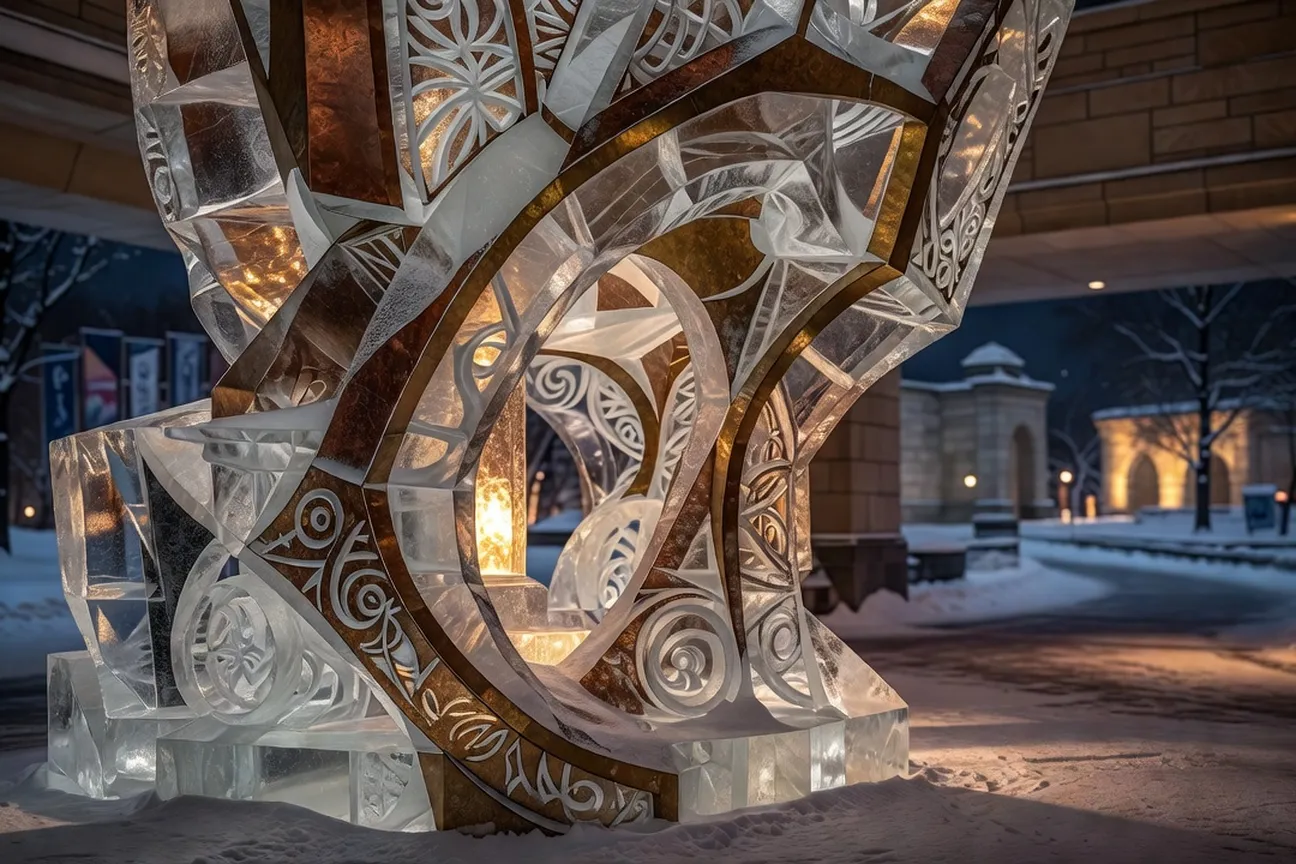
Typical entries depict subjects drawn from Canadian wildlife, historical figures, or abstract geometric forms. Past editions have included pieces with internal LED lighting that illuminates translucent sections of the ice after dark, as well as entries referencing Ottawa landmarks alongside more abstract or purely animal-themed designs — the lineup changes with each year’s competing teams. Visitors approach the sculptures along cleared pathways lined with low barriers that keep foot traffic at least one metre from each piece, reducing the risk of accidental contact damage. Park staff conduct twice-daily inspections, measuring surface temperature and checking for hairline fractures that can develop when wind removes the insulating layer of still air around the ice.
The full year-round event calendar lives in our festivals and events of Ottawa field guide — Winterlude in February, the Tulip Festival in May, Bluesfest in July.
Lighting design forms an integral part of the evening experience. Strings of low-wattage LED fixtures are suspended from temporary poles at a height of four metres, angled to graze the surfaces of the sculptures rather than flood them from above. This technique accentuates the internal textures created during carving, such as the parallel ridges left by chainsaw cuts or the smoother planes produced by hand chisels. The park closes at ten o’clock each night, after which crews reduce illumination to security levels only. For those planning a broader winter itinerary, the festivals and events of Ottawa page lists additional installations that run concurrently in other neighbourhoods.
Jacques-Cartier snow slides for families
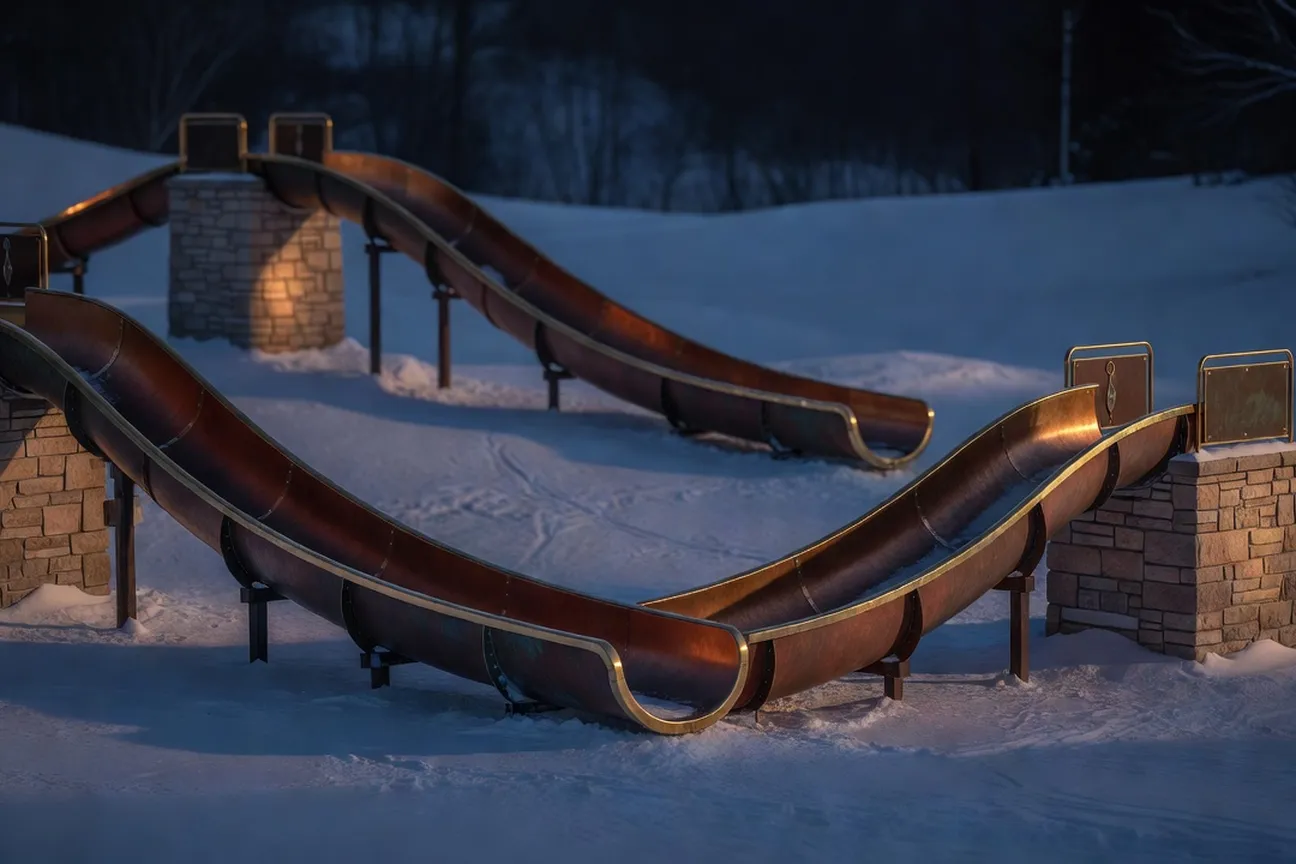
Jacques-Cartier Park lies on the Gatineau side of the Ottawa River, directly across from the downtown core and reachable by foot via the Alexandra Bridge or by the shuttle buses that operate every fifteen minutes during festival hours. The park’s central feature during Winterlude is a series of snow slides constructed from compacted snow and finished with a thin layer of ice. The main slide is a long, steep run built for older kids and adults, while shorter, gentler runs are set aside for younger children. All slides terminate in a flat run-out zone bordered by snow walls two metres high to contain any overshoot.
Construction begins in early January when crews pile snow from adjacent parking areas into long berms. Once the piles reach sufficient height, workers compress the material with tracked machinery and then carve the running surfaces with handheld tools. The finished slides receive a daily application of water sprayed from hoses; the water freezes into a smooth glaze that reduces friction and prevents the snow from becoming granular. Operators monitor the surface temperature throughout the day and close individual runs for fifteen-minute intervals when fresh snow begins to accumulate. Helmets are not mandatory but are available for loan at the base of each slide without charge; children under twelve must be accompanied by an adult when using the longer run.
Adjacent to the slides, the park contains a snow-play area equipped with low mounds, tunnels, and small climbing structures. The area opens at nine in the morning and closes at eight in the evening. Entry remains free; check the official Winterlude site for current details on any equipment rentals available at the slides. First-aid stations staffed by certified attendants stand at both the top and bottom of the main run, and a public address system issues announcements in English and French when capacity limits are approached. The site connects directly to additional winter trails that extend into Gatineau Park, allowing visitors to combine a slide session with a short snowshoe outing before returning across the river. Further planning resources appear on voyage-canada.com.
Travellers based in France will find our partner timetours-voyages.fr covers similar ground in French.
Skating the canal in festival week
The Rideau Canal Skateway opens for public use well before Winterlude begins, yet the festival weeks bring extended lighting, nightly music stages, and a continuous line of ice sculptures set directly on the ice surface between Fifth Avenue and the National Arts Centre. Visitors typically enter at the Dow’s Lake pavilion, where rental kiosks supply standard hockey skates and helmet add-ons; consult the National Capital Commission’s official Skateway page for current rental pricing. The maintained surface stretches for several kilometres toward downtown, with ice thickness monitored by NCC crews at access points throughout the season.
Skaters move at a comfortable pace when the corridor is uncrowded, faster near the centre of the lane. During festival evenings the canal stays open later than its usual hours, with lighting installed along the route for visibility. Surface grooming takes place overnight and in the early morning, producing a consistent texture that reduces slip risk even after daytime thaw. Temperatures during the first festival weekend usually range between minus 8 and minus 14 degrees Celsius in late afternoon, rising briefly above freezing on the final Sunday in roughly one year out of three.
Our French-language partner voyage-canada.com covers similar editorial ground for francophone readers planning a cross-country trip.
Along the route, crews maintain figurative and abstract ice sculptures set directly on the canal surface, recutting detail as needed so the pieces stay sharp through the weekend. Food concessions are spaced along the ice, generally offering beverages and packaged snacks rather than hot meals, since open flames and hot-food preparation are restricted on the ice itself. First-aid stations operate at several points along the route, each equipped for cold-weather emergencies.
Further practical information on canal maintenance and seasonal closures is contained in the Rideau Canal field guide. The same document lists the precise coordinates of every emergency exit stair, useful when wind speeds exceed 25 kilometres per hour and skaters seek the nearest shelter.
Logistics: transit, parking, BeaverTails
The ice holds its temperature longer than the surrounding air, which is why the canal can remain usable even when sidewalks have already turned to slush.
Several OC Transpo bus routes stop near the Lansdowne and Fifth Avenue entrances, with schedules typically running frequently during daytime hours throughout February; check the OC Transpo site for current routes, frequency, and fares, since these are updated regularly and paid by exact change or Presto card. Parking is available at surface lots near Dow’s Lake, with rates and time limits posted on site — arrive early on weekends, as spaces near the canal fill quickly.
BeaverTails stands operate at fixed canal locations, including near Dow’s Lake and the National Arts Centre stairs. Prices vary by topping — the classic cinnamon-sugar pastry is generally the cheapest option, with specialty toppings costing more — so check current pricing at the stand or on the BeaverTails site. Expect a queue, especially once the morning rush picks up. Hot chocolate is also sold at most stands and remains available until closing.
Travel planning resources published on voyage-canada.com list current shuttle schedules from Gatineau hotels and note which park-and-ride lots fill first on Saturday mornings. Visitors arriving by car after 11:00 on the second festival weekend should expect a 15-minute walk from the nearest available parking to the nearest skate rental kiosk.
Which weekend to choose
Deciding which weekend to book fits into the wider question of the best time to visit Ottawa, since Winterlude sits at the coldest point of the city’s calendar. Winterlude occupies three consecutive weekends in February, each carrying a distinct pattern of attendance and programming. The opening weekend centres on the official ice-sculpture competition judged on the Saturday; judging concludes by 16:00, after which the public may approach the 12 finalist blocks without barriers. Crowds peak between 13:00 and 17:00, yet the canal surface itself rarely reaches capacity because many spectators remain on the adjacent pedestrian paths. Average daytime temperatures for this weekend sit near minus 9 degrees Celsius, with wind chill occasionally reaching minus 18.
For the canal’s full hydrological and historical arc, see our Rideau Canal UNESCO field guide.
The middle weekend introduces the snow playground at Jacques-Cartier Park and the ice-luging track beside the Rideau Canal. Both installations open at 10:00 and close at 20:00. This weekend tends to draw larger daytime crowds than the opening weekend, concentrated in the early afternoon. Evening canal skating remains comparatively quiet after 19:00 once the playground closes. Snowfall is a realistic possibility on any given day of the festival, so dress and plan accordingly.
The closing weekend features the bed race on the ice on Sunday morning and the final fireworks display at 20:30 on Saturday. Temperatures are statistically the mildest of the three weekends, averaging minus 6 degrees Celsius, which can produce softer ice and more frequent grooming interruptions. The fireworks draw large crowds along the Queen Elizabeth Drive embankment; canal entry points south of the National Arts Centre become congested from 19:00 onward. Visitors who prefer fewer people and firmer ice therefore select the first weekend, while those seeking the greatest number of side events accept the middle or final weekend despite higher densities.
| Weekend | Average temperature | Signature event | Crowd level |
|---|---|---|---|
| Opening | ~−9°C | Ice-sculpture competition judging | Moderate, peaks 13:00–17:00 |
| Middle | Colder, more snowfall likely | Snow playground and ice-luging open | Higher daily visitation than opening weekend |
| Closing | ~−6°C, mildest | Bed race and fireworks | Highest, large fireworks crowds |
In short, pick your weekend based on priorities:
- First weekend for firmer ice and smaller crowds around the sculptures
- Middle weekend for the snow playground and ice-luging alongside the canal
- Closing weekend for the fireworks and bed race, accepting denser crowds
Heads up: Canal entry points south of the National Arts Centre get congested from 19:00 onward on the closing Saturday — arrive early or pick a different access point if you want to watch the fireworks from the ice itself.
Additional context on seasonal patterns appears in the festivals and events of Ottawa section of the magazine archive. Attendance data there also cover the impact of weekday holidays that occasionally shift visitor distribution.
The canal skating route and the surrounding festival grounds together create a single continuous public space that changes character each day yet remains legible through consistent lighting and signage. The cumulative effect is less a sequence of discrete attractions than a repeated traversal of the same long canal corridor under varying light and crowd conditions. Over three weekends the ice itself records the passage of thousands of blades, each pass contributing to the surface texture that subsequent skaters inherit.
Frequently asked
Winterlude is an annual winter festival held in Ottawa, Canada, celebrating the beauty and fun of the winter season. It typically takes place over the first three weekends of February, featuring activities such as ice sculptures, skating, and more.
The ice sculptures are prominently displayed at Confederation Park, also known as the Crystal Garden, located in downtown Ottawa. This venue is easily accessible and offers a stunning showcase of intricate ice carvings by artists from around the world.
Viewing the ice sculptures at Confederation Park is free of charge. However, there might be additional costs if you choose to participate in other activities or purchase food and beverages at the festival.
The ice sculpture displays are generally accessible to the public from 8:00 AM to 11:00 PM daily throughout the festival. It's advisable to visit during the daytime to fully appreciate the details of the sculptures, although evening visits offer a magical experience with the sculptures illuminated.
Confederation Park is centrally located and easily reached by public transit, with several OC Transpo bus routes passing nearby. If you're driving, there are parking options in the vicinity, but spaces can fill up quickly during the festival, so public transport is recommended.